Three Country Boys, a Whistle, and a 7-Foot Black Figure: Inside the Hodgenville Bigfoot Encounter
On the night of August 23, 2026, three friends riding back roads off Howardstown Road near Hodgenville, Kentucky — roughly 50 miles south of Louisville — stopped at a lookout along a gravel road and heard a distant wood knock. One of them whistled back. The woods answered with breaking sticks. They drove down to the turnaround, came back, and this time witness Clayton Sims hit the woods with a spotlight. About 40 yards in, a jet-black, 7-to-8-foot bipedal figure with a cone-shaped head and yellowish-green eye-shine briefly turned to check if they were still there. It's the second BFRO report ever logged in Larue County, and the case file just dropped this week via BFRO Investigator Charlie Raymond, the founder of the Kentucky Bigfoot Research Organization. Coast to Coast AM picked it up on Monday. Here's the full breakdown.
What Clayton Sims Saw on River Road
The encounter is filed as BFRO Report #82512, classified Class B, with a recorded Zoom interview between Sims and Charlie Raymond. Per the BFRO write-up, the events of the night unfolded in roughly this order:
Sims and two friends were cruising back roads close to his house — a small public gravel road off Howardstown Road (Kentucky Route 84) called River Road, not far from the Rolling Fork Wildlife Management Area. They stopped at a lookout point, got out of their vehicles, and stood in the dark. After about 20 seconds of silence, they heard what sounded like a distant knock. One of his friends said, "Whistle or howl. It could be a Bigfoot."
Sims let out a long whistle. Almost immediately, the woods responded with what sounded like sticks or saplings breaking — moving closer.
They jumped back in the trucks, drove down the road to turn around, and stopped at the same lookout on the way back. This time they stayed in the vehicles. Sims swept a spotlight into the tree line.
"I seen around 40 yards away from the truck a black hairy figure that was so dark I couldn't see it until it moved. It was around 7 to 8 feet tall. Its back was turned to me but it slightly turned to us as if it was checking to see if we was still there. The outline of the face was ape like with the cone kinda shaped head and a yellowish green eye shine. At that moment I told my friend to get out of there. He floors it."
— Clayton Sims, BFRO Report #82512 (Class B)
The whole visual encounter lasted roughly five seconds before fear took over and they pulled out.
What Charlie Raymond Saw in the Interview
The BFRO investigator on the case is Charlie Raymond, founder of the Kentucky Bigfoot Research Organization and the most prolific Bigfoot field interviewer in the commonwealth. He has personally interviewed more than 300 credible Kentucky witnesses over a 30-year career, has appeared on Animal Planet, the History Channel, and the BBC, and has spent more time in central-Kentucky knobs and hollows than just about anyone alive.
On the Zoom call — which Raymond has published publicly on YouTube — he walked Sims through the night in detail. From Raymond's follow-up investigation summary in the BFRO file, the visual description sharpened up considerably on the second pass:
- Distance: Sims illuminated the figure with a bright hunting light at roughly 50–60 yards through the trees.
- Height: 7–8 feet, with an extremely bulky build and 3-to-3.5-foot-wide shoulders.
- Build: thick chest, very short thick neck, jet-black long hair with wiry hair around the shoulders.
- Posture: hunkered down with arms tucked close to the body, keeping its back to them as though attempting to remain hidden.
- Head: somewhat conical/elongated, with bright greenish-yellow eye-shine and a protruding, gorilla-like face that was longer than a human face but without a true muzzle.
- Face: dark brown compared to the black body hair.
- Length of visual contact: about five seconds — long enough to read the silhouette, not long enough to draw a portrait.
Raymond also walked Sims back through the audio sequence. About 10 minutes before the spotlight visual, the group had heard two distinct wood-knock patterns — the second noticeably closer, after Sims responded to the first sound with a long whistle. That two-knock "closer after a response" pattern is one of the things KBRO has spent decades documenting in central Kentucky. It's the kind of behavioral detail that turns a single visual into a coordinated audio-visual report.
"I found the witness credible. His story remained consistent from his online submission, text messages, initial phone call and his video interview. The creature's physical description and behavior (return tree knocks, trying to hide/avoid the light) are typical. Agreeing to a video interview, he has more to risk (ridicule from his buddies), than the reward (attention)."
— Charlie Raymond, BFRO follow-up investigation summary
Why Larue County Matters
The geographic piece is what makes this one interesting for heartland readers. Larue County sits in the central-Kentucky knob region, just east of I-65 and just south of the Lincoln Birthplace National Historical Park. The county seat — Hodgenville — is roughly 50 miles south of Louisville and 25 miles south of the Bourbon Trail. Rolling Fork, the river Raymond mentions in his report, drains a thick stretch of knobs, hollows, soybean bottoms, and cornfields that runs almost unbroken south toward the Green River.
Before this month, Larue County had just one entry in the entire BFRO database — a Class A 2016 report from a homeowner near Campbellsville describing "sightings and constant activity." Two reports in the entire history of the BFRO, both within the last decade, both Class B or higher, both within roughly 10 miles of each other.
That's a thin record — but it's a record that matches the terrain. The Rolling Fork / Nolin River drainage has all the ingredients KBRO and BFRO look for: heavy hardwood canopy, ridge-and-hollow topography, a long rural road network that doesn't see much traffic after dark, and proximity to the broader Mammoth Cave / Barren River / Green River system that has quietly produced Kentucky Bigfoot reports since at least the 1970s.
The Whistle-and-Response Pattern
One detail in the BFRO file that's worth pulling out: Sims didn't just hear a knock and flee. He and his friends stood in the silence, discussed the possibility that the sound was Bigfoot, and then intentionally whistled back. The woods responded with movement — sticks or saplings breaking, closing distance. Then, on the way back past the same lookout, they got the spotlight visual.
This is the second time in three months we've written about a deliberate whistle-and-response on a heartland Bigfoot case — the first was the August 2026 mini-Bigfoot cluster in Stan Gordon's Indiana County, PA file. Researchers who've spent decades in the woods have a name for this pattern. So do the skeptics. We won't relitigate that here. We will note that the response pattern in both cases came back closer, and that in both cases the response pattern was followed within minutes by a visual.
KBRO and BFRO both treat deliberate call-and-response as a Class-A-friendly trigger for getting a closer look. It's also the kind of behavior that creates exactly the scenario we saw at Hodgenville: a quiet dark road, a small group of curious locals, a vocalization, and a decision to either investigate or to leave. The Hodgenville group did both, in sequence.
The Other Stories Sims Mentioned
One of the most useful parts of the BFRO file is the "other stories" field Sims filled out. It's a one-liner but it ties the Hodgenville incident to a much wider local pattern:
"We have heard stories of other people such as coon hunters who have had hounds disappear during the night and finding the tracking collars hanging in trees where there are no people anywhere around."
— Clayton Sims, BFRO #82512
Lost hounds and radio collars hung in trees — that's a recurring central-Kentucky Bigfoot folk pattern, the same one that shows up in the long-running "coon hunters lose dogs" stories from the Daniel Boone, Hoosier, and Shawnee national forests. It's anecdotal, it's hard to verify, and it's exactly the kind of detail that makes a Class B report feel Class A-shaped.
The National Coverage
Coast to Coast AM ran the story Monday, September 21, 2026, framing the Hodgenville encounter as a "frightening turn" for a group of friends on a Kentucky dirt road. KFI AM 640 syndicated the piece across the iHeart network. It's the second time in three weeks a heartland Bigfoot case file has popped up on national talk radio — the March Ohio Flap got the same treatment in May.
Worth noting: the Coast to Coast piece keeps the BFRO / KBRO sourcing and leans on the same witness and the same investigator. That's the right move. The Hodgenville case isn't a tabloid Bigfoot story. It's a Class B report with a recorded witness interview, a credible local investigator, and a physical description that matches the broader central-Kentucky Bigfoot profile KBRO has been documenting for 30 years.
Watch the Promo
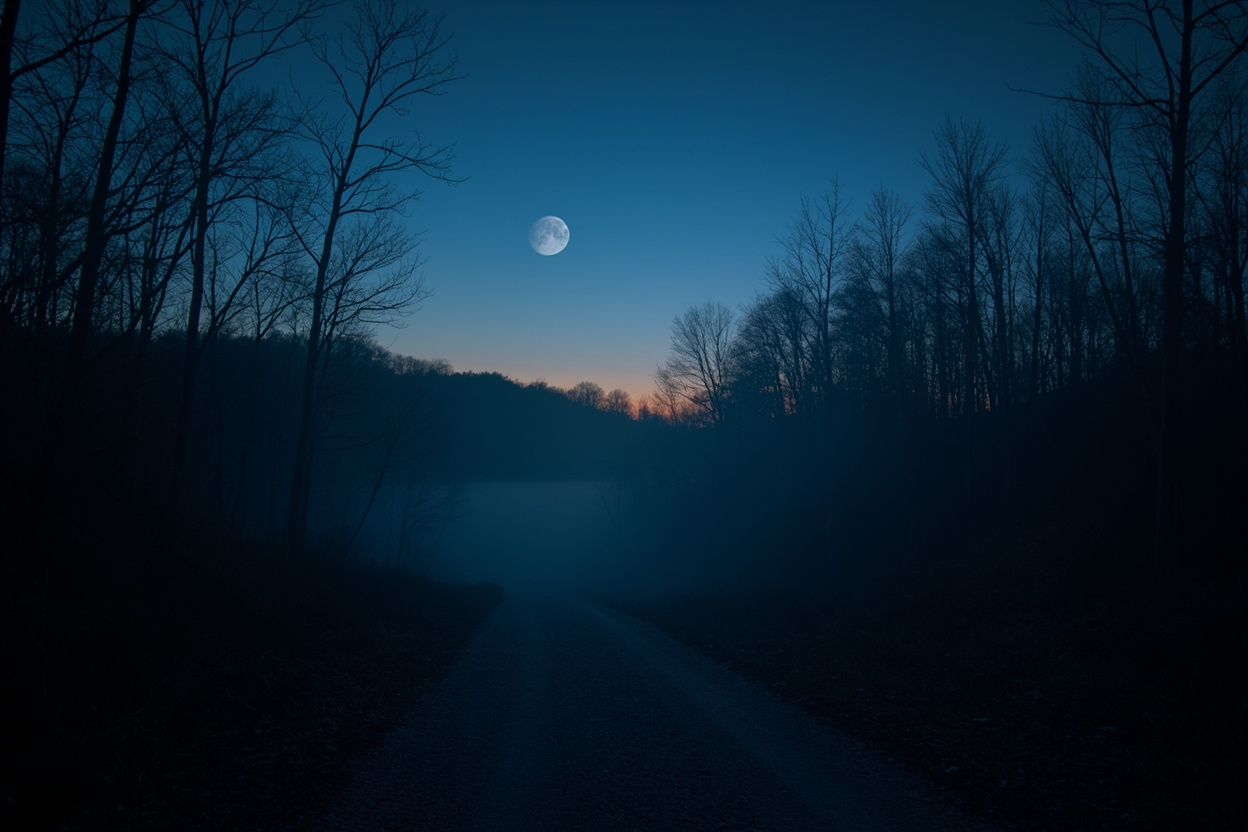
We put together a short TikTok promo for this one — moonlit central Kentucky knobs, low fog, the kind of full-moon night Sims described. Watch it below and let us know if you've had a similar experience off Howardstown Road or anywhere in the Rolling Fork drainage.
🎬 TikTok promo: Video pending — generation providers hit their daily limits on this run. Promo clip will be posted to @cletus_5353 once credits refresh.
Seen something in Indiana, Kentucky, or Ohio? Submit your sighting →
Sources:
• BFRO Report #82512 — Country boys have frightening nighttime encounter 50 miles south of Louisville (Class B, August 23, 2026)
• BFRO — Larue County, Kentucky Reports & Articles
• Charlie Raymond's Zoom interview with Clayton Sims — Kentucky Bigfoot Research Organization (YouTube)
• KFI AM 640 / Coast to Coast AM — Bigfoot Sighting Reported in Kentucky (Sep 21, 2026)
• Coast to Coast AM — Bigfoot Sighting Reported in Kentucky
• BFRO — Reports for Kentucky
• BFRO — Kentucky Bigfoot Expeditions (Charlie Raymond)